Deuteronomy 5:12-15
Breathe on us, Breath of God, fill us with life anew. Teach us to love as thou wouldst love and do as thou wouldst do. Amen.
In late May, I traveled to Austin, Texas with MARCH (Multifaith Anti-Racism, Change & Healing) colleagues, Rabbi Arielle Lekach-Rosenberg from Shir Tikvah and Rev. Hierald Osorto from San Pablo’s Lutheran Church. (Hierald is also Pastor Ben Master’s husband.) We were the first of two delegations that MARCH sent to begin to cultivate relationship with multifaith colleagues in Texas because so many of our Minnesota neighbors abducted by ICE have been sent to detention there.
Our trip began by meeting with Dr. Gregory Cuellar, a Hebrew Bible scholar, artist, and activist from Austin Presbyterian seminary. The very first thing Dr. Cuellar had us do was spend time at The Benson, which is the Latin American library at the University of Texas, reading the work of Gloria Anzaldua, a lesbian Chicana scholar and activist who died in 2004. Dr. Cuellar had set aside several of her essays that he insisted we hold and read before we did anything else in Texas. Because Anzaldua’s writing had formed some of the most important ground on which I stood during my own coming out journey, I was thrilled to be able to read her drafts of essays on spiritual activism.
But Dr. Cuellar wanted to be explicit about why he asked us to start at The Benson. He said, for him, two of the most important lessons from Anzaldua’s writing are her exploration of nepantlas and altares/altars. Nepantla is a Nahuatl word that means “in-between space” or “crack.” She talks about the importance of nepantlas when a community is operating amidst deep suffering and oppression. When it seems like the dominant culture or Empire or oppression are all-powerful, it is critically important to remember that every system has nepantlas, has cracks, has spaces where resistance and resilience grow and thrive.
Anzaldua’s other point was the role that altares/altars play. Altars are some of the most important nepantlas there are. Altars can be a physical altar in our homes, they can be how we tattoo our bodies, they can be our gardens. But altars are spaces and times where we claim our humanity, our authenticity, our beauty, our joy. They are places and times where Empire or oppression don’t hold sway.
Dr. Cuellar wanted us to be grounded in the long, long history of nepantlas and altares in Texas, particularly amongst Latine and queer communities before we engaged in the history of the American Empire and its present manifestation in ICE. He then shared with us images from a stations of the cross project he had done with Operation Identification called Arte de Lagrimas: Refugee Artwork Project. The project used photos that Operation Identification had taken of the tattoos and the prayer cards and other sacred objects found on the bodies of people who had died in the Texas desert. The photos were originally used to help beloveds know what had happened to their kin. But this project created a stations of the cross in which participants were invited to view one or two photos and read the descriptions and then read outloud the prayers that those who had died had carried and likely prayed as they made their journey.
Dr Cuellar brought the photos out of storage for us to see and experience because he believes they form an important lens through which to do this ongoing neighboring and resisting of State violence. He wanted us to see the color and beauty and deep faith and joy AND the brutality of Empire’s dehumanizing violence. The tattoos were a concrete example of Anzaldua’s nepantlas and the creation of an altar. Tattoos of the Virgen de Guadalupe and Jesus and their loved ones… each tattoo was a claiming of their own humanity, beauty and power. And rooting in hope. Both Anzaldua and Dr Cuellar urged/implored us to remember the cracks in Empire’s violence, remember the hope, remember the joy.
It reminded me of my seminary professors teaching me that I must never preach about crucifixion without resurrection nor resurrection without crucifixion.[1]
As we do this work of resisting the growing authoritarianism and the ongoing violence of the Doctrine of Discovery, we must tell the truth of the violence and terror…and we must tell the truth of the love, joy, beauty, and power of the resistance.
The next day, Arielle and I visited the Hutto Detention Center, a private prison that only holds people on Administrative holds, meaning none of the people held there have any criminal charges. As we walked through the double 20-foot-high gates topped by razor wire, we were overwhelmed by the banality of evil as we were met with the banner above the check-in desk that read, Happy Correction Workers Appreciation Week as we passed people carrying cupcakes and balloons as they left work. Meanwhile, we met with a man who was kidnapped from the semi he was operating legally while he was in a legal asylum process. He’d been in Hutto for five months without a visitor. His wife had given birth to their first child by herself. And still, he and other detainees had been on strike, protesting the ill treatment and the wages that paid kitchen workers $3/day, laundry workers $2/day and cleaners $1/day and the fact that a phone call costs $ .21/min so it can take several days’ worth of work in order to pay for one phone call. Meanwhile, our taxes pay the privately-owned Hutto detention center $1000/day per detainee. And the man we visited fasted 1 ½ days a week and prayed and led worship services for others every day, sometimes twice a day. His arms were covered in beautiful tattoos…
Nepantlas… altars… resistance… resilience…
Observe the Sabbath day and keep it holy, as the Holy One your God commanded you. Six days you shall labor and do all your work. But the seventh day is a Sabbath to the Holy One your God; you shall not do any work—you, or your children, or your slaves of any gender, or your ox or your donkey, or any of your livestock, or the resident alien in your towns, so that your slaves of any gender may rest as well as you. Remember that you were a slave in the land of Egypt, and the Holy One your God brought you out from there with a mighty hand and an outstretched arm; therefore the Holy One your God commanded you to keep the Sabbath day.
We are considering Sabbath practice this morning.
Our text is from Deuteronomy and comes from the Ten Commandments. The Ten Commandments offer our ancestors and us a grounding in both things NOT to do and things TO DO that keep the community clear about who and whose we are. They are a strategy for rooting ourselves in sacred community and relationship with God as well as being able to resist the logic of Pharoah, and the logic of Rome, and the logic of the American Empire…
Our text for this morning lifts up keeping the Sabbath and explicitly talks about the entire community—including people of all ages, those who are resident aliens, those who are slaves, and all animals—everyone refraining from work and resting. In practice this commandment to NOT work on the Sabbath is paired with the tradition that you DO eat good food and sing and have conversation and tell stories. In some Orthodox Jewish traditions, it is a mikvah, a particular blessing, to have sex on the Sabbath.
The Sabbath is a deeply somatic, embodied experience. Refraining from work, which is an economic break, almost like a mini-Labor Day every week, is paired with deep community and relationship and somatic healing and rest. It is a time to remember our own humanity and the sacredness of all of creation.
Elsewhere in the biblical text, there is an explicit connection between the Sabbath, practiced every seven days and Sabbatical which is a deep rest for the land which is practiced every seven years. And the Sabbath and the sabbatical are deeply connected to Jubilee, which is the re-distribution of all assets which happens every seven times seven years.
The command to keep the Sabbath is given amidst the escape from Pharaoh’s enslavement. It is an explicit contrast to the ways of Pharaoh. And as Jesus and the early Christian community practiced sabbath, it was a stark contrast to the ways of Rome. And the invitation to us to keep the Sabbath, to rest, to eat good food, to relish in community and connection and our bodies… it is all in stark contrast to the ways of the American Empire.
The American Empire under which we are living has sought to commodify time… time is money. And this capitalist worldview means that everything is urgent. And only certain people may rest because only certain people are human. And certainly the land never rests… and re-distribution of resources is anathema.
But we are invited to be Sabbath-practicing people. It isn’t particularly complex. But Sabbath practice amidst the American Empire is the deepest kind of resistance. Put another way, sabbath practice is a nepantla… it is an altar…
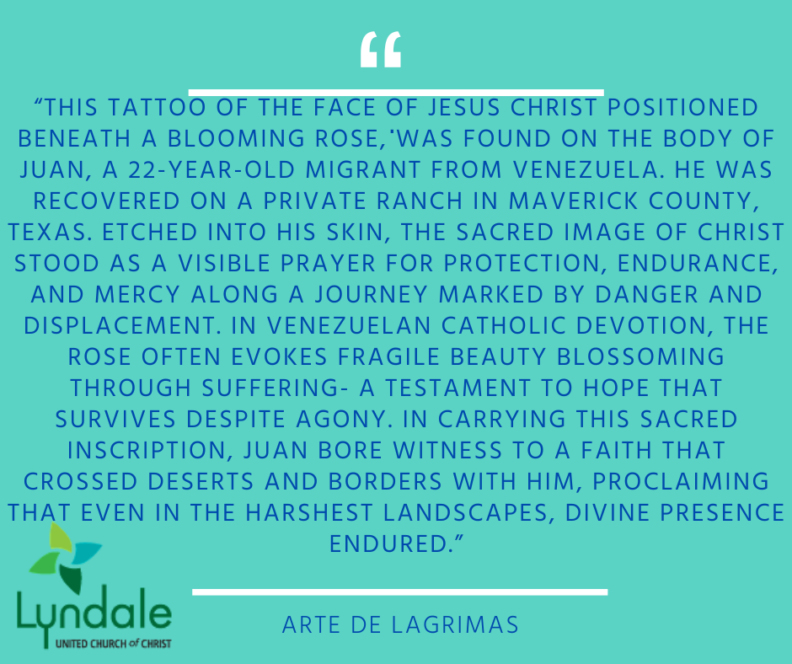
One of the photos in the Arte de Lagrimas stations of the cross exhibit is of a tattoo of Jesus set below a rose. The card next to it reads,
“This tattoo of the face of Jesus Christ positioned beneath a blooming rose, was found on the body of Juan, a 22-year-old migrant from Venezuela. He was recovered on a private ranch in Maverick County, Texas. Etched into his skin, the sacred image of Christ stood as a visible prayer for protection, endurance, and mercy along a journey marked by danger and displacement. In Venezuelan Catholic devotion, the rose often evokes fragile beauty blossoming through suffering- a testament to hope that survives despite agony. In carrying this sacred inscription, Juan bore witness to a faith that crossed deserts and borders with him, proclaiming that even in the harshest landscapes, Divine presence endured.”
Nepantlas… altars… resistance… resilience. May it be so.
[1] Rev Dr Stephen Ray and Rev Dr Serene Jones in particular.
Recent Comments